
Rashinee Mitchell heard it before she felt it. A sharp crack the kind of sound that registers as a different category from road noise followed immediately by a thud against the lower front section of her car. She was northbound on I-45, approximately a mile south of the Bay Area Boulevard exit, doing sixty in moderate traffic, when the piece of re-tread that had separated from a truck three vehicles ahead reached her.
She gripped the wheel, checked her mirrors, and moved to the right lane before doing anything else. The car tracked normally. The steering felt no different. The engine showed nothing unusual on the dashboard. She brought the speed down, took the next exit, and pulled into the parking lot of the first commercial strip she saw.
She walked around the front of the car.
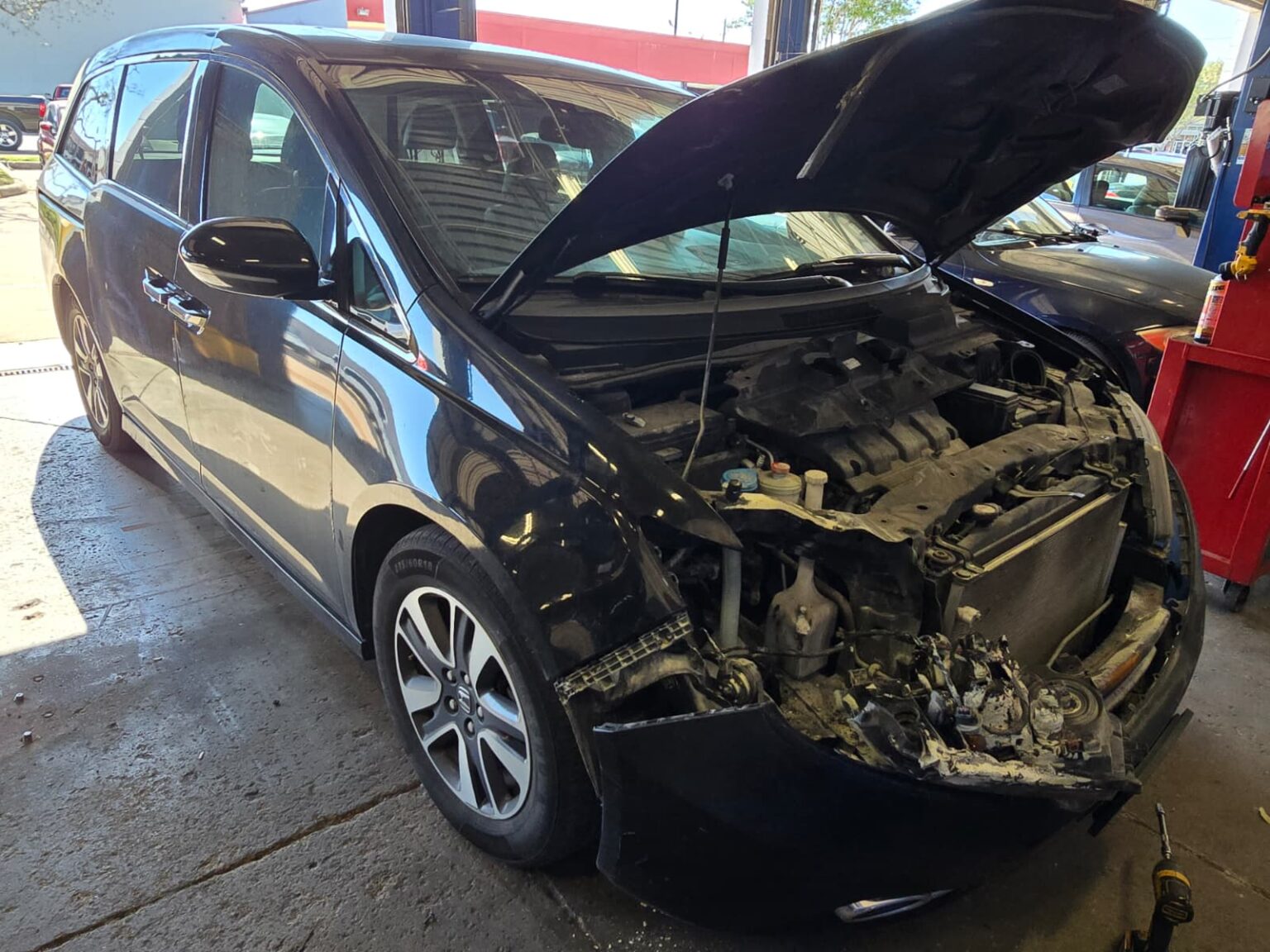
The impact point was the lower section of the front bumper fascia — the area below the grille and above the front air dam. A crack, roughly six inches in length, ran diagonally across the bumper skin. The edges of the crack had already begun to splay slightly outward, the plastic bending away from itself at the break point. The paint across the crack had fractured and chipped in a pattern that followed the crack edge, exposing the grey primer and raw plastic beneath. A scuff mark from the debris itself a rubbery, dark streak cut across the front fascia from the impact trajectory.
She photographed everything, checked that nothing was dragging beneath the car, and drove to her appointment carefully, and with the clear intention to have this looked at properly rather than hoping it would be fine.
That evening, she searched for an Auto Repair Shop Webster Texas with specific experience in collision and body work, and called Bay Area Auto.
Why Rashinee Did Not Dismiss It as Minor
Most highway debris strikes that do not disable the vehicle or affect its handling produce one immediate response in the driver: relief that it wasn’t worse. That relief, when it fades, often becomes a rationalisation — it’s just cosmetic, it’s not that bad, I’ll deal with it eventually.
Rashinee had a different instinct, and it came from having owned enough vehicles to know that “minor” body damage almost always means minor only at the moment of impact, not in what follows.
The plastic bumper skin that had cracked was not only an aesthetic component. It was the outer layer of a system. Behind the bumper cover was a foam or plastic energy absorber designed to compress and protect the vehicle structure in more significant impacts and the absorber’s ability to do its job depended on the bumper cover holding its shape properly. A cracked cover can allow the absorber to shift or be exposed in a way that compromises its next performance.
The crack also exposed raw plastic and primer to the elements. Front bumpers on vehicles driven regularly on Texas highways are exposed to UV light, road moisture, temperature cycling, and significant road spray. A crack that exposes the raw plastic beneath the paint is a crack that will absorb UV radiation, which causes plastic brittleness and crack propagation the crack grows wider, not narrower, with time and temperature.
And there was the scuff mark from the debris itself which might be surface or might indicate the force of the impact had been distributed into the plastic in ways not visible at the crack alone.
She called the next morning.
The Call with Eric
Eric answered, and Rashinee described the damage: the six-inch diagonal crack, the paint chipping from the crack edges, the scuff mark from the debris across the fascia, and the fact that the car had driven normally after the impact.
Eric: The diagonal pattern you’re describing starting at a point and spreading across the lower fascia is consistent with a debris strike at speed rather than a contact impact from another vehicle. The diagonal stress propagation follows the direction of impact rather than spreading evenly. Has the crack spread at all since you first looked at it?
Rashinee: It might be slightly wider at one end than when I first photographed it. It’s hard to tell.
Eric: That’s typical. The plastic at the crack edges is under tension it wants to continue splitting. Temperature change accelerates it. Bring it in and we’ll assess the full extent of the crack, check whether the absorber behind the cover was affected, and look at a couple of other things I want to check on a debris strike to the front bumper specifically.
Rashinee: What other things?
Eric: Modern vehicles have pedestrian detection sensors and in some cases radar units positioned in the lower bumper area. A debris impact that puts enough force through the lower fascia to crack the plastic can shift those sensor brackets without the sensors themselves being visibly damaged. It’s worth checking before we repair anything cosmetic, because a sensor that has moved in its mounting doesn’t get corrected by a bumper repair it needs its own attention.
Rashinee had not thought about sensors. She appreciated that Eric had.
She made an appointment for the following morning.
Rashinee Arrives at the Auto Repair Shop Webster Texas
When Eric examined the car, he started with the crack itself — running his finger along the entire length and checking both ends for where the crack ended or whether it had already branched.
Eric: The crack has branched at the upper end — there’s a secondary hairline about an inch and a half long branching off toward the centre of the fascia at about forty-five degrees. That branch isn’t visible unless you’re specifically looking for it, but it tells me the force of the impact was significant enough to propagate beyond the primary crack line. If we repair only the visible crack without addressing the branch, the branch will continue to grow and you’ll be back for a second repair in a season or two.
He then pressed carefully along the bumper’s surface on either side of the crack.
Eric: The plastic is flexing more freely at the crack than it should — there’s some separation of the outer skin from the inner structure of the cover in the area immediately around the impact. That means this is not a surface crack only — the material has delaminated slightly at the impact point. Repairing this correctly means addressing the structural bond of the plastic as well as the surface crack, not just filling and painting.
He crouched down and ran his hand along the lower edge of the bumper cover.
Eric: The cover is still seated in its clips along the lower edge, which is good. The absorber behind it hasn’t been exposed. But I want to access the back of the bumper in one area to confirm the internal bracket for the pedestrian detection sensor is still correctly seated — that’s in the lower centre section which took the highest concentration of force from what you’ve described.
What the Full Inspection Found
With access to the inner side of the bumper cover, Eric was able to confirm two things: the energy absorber behind the cover was intact and in its correct position, and the pedestrian detection sensor mounting bracket had shifted fractionally not enough to be visible from outside, but measurable against its original seated position.
Eric: The sensor bracket has moved approximately three millimetres from its centred mounting position. That’s a small amount, but pedestrian detection systems rely on precise forward and downward aim to detect objects at the correct distance and angle in front of the vehicle. Three millimetres of lateral shift in the bracket translates to a meaningful change in the sensor’s coverage area.
Rashinee: Is that affecting the system right now?
Eric: The system may still appear to function it may not have triggered a fault code because the shift isn’t dramatic enough for the self-check to flag it. But it’s covering a slightly different zone than it’s designed to. We need to reseat the bracket and verify the sensor position after the bumper repair is complete.
He prepared the written estimate before any work began, itemizing each component of the repair and explaining the reasoning for each decision.
The Repair Complete and Properly Sequenced
The full Collision Repair in Webster, Texas on Rashinee’s vehicle followed the correct sequence for a bumper strike of this type:
- Bumper cover removal — The cover was fully removed to allow proper access to the inner surface, absorber, and sensor bracket
- Sensor bracket reseating — The pedestrian detection sensor bracket was returned to its original centred mounting position and confirmed secure before any cosmetic work began
- Crack repair — inner and outer surface — The primary crack and the secondary branch were repaired from the inner side first, using a plastic welding process to restore the structural bond of the material before any filler work was applied to the outer surface. Inner repair first is the correct sequence — filling the outside while the inner structure is still compromised produces a repair that looks correct initially but re-cracks from the inside out within months
- Delamination area re-bonded — The area of inner skin separation from the outer layer was re-bonded and clamped, restoring the structural integrity of the cover panel at the impact area
- Surface preparation — The outer crack area was sanded, block-filled to restore the correct surface profile, and guide-coated to confirm the surface was flat and even before primer was applied
- Primer application — The repaired area was primed with an appropriate adhesion primer formulated for flexible plastic substrates — standard metal primer does not bond correctly to the flexing plastic of a bumper cover and will crack with normal flex
- Paint application and blending — The bumper cover was resprayed with the factory colour code, adjusted for the vehicle’s age-related weathering, and blended into the headlight surround area where the colour would have been visible at the repair boundary
- Clear coat application and cure — Two coats of clear were applied and allowed to cure fully
- Reinstallation and sensor check — The cover was reinstalled, all clips confirmed seated, and the pedestrian detection sensor was checked for correct position and function before the vehicle was released
- Test drive and system verification — The vehicle was driven to confirm no warning lights related to the front sensor systems and normal operation through a range of driving conditions
Rashinee Picks Up the Car
When Eric returned the keys, Rashinee walked to the front of the car and looked at the bumper.
The crack was gone. The scuff mark was gone. The chipped paint line that had been following the crack edge was gone. The paint matched the surrounding panels. The bumper sat evenly in its clips with no visible seam or texture difference at the repair area.
Rashinee: I can see the repair if I’m looking for it?
Eric: Try.
She crouched down and looked at the repair area from the angle where the light hit it at the sharpest.
Rashinee: I can’t find it.
Eric: That’s a correctly executed repair. Not magic — just the right prep work and the right sequence.
She also mentioned, as they walked back inside, that she had looked up highway debris strikes and found varying opinions online about whether cracked bumpers needed proper repair or could simply be left or sealed with a surface compound.
Eric: A surface compound or filler applied to the outside of an unsealed crack in flexible plastic does two things: it looks better than the crack for a while, and then it fails, usually starting at the point where the fill meets the original crack, because the plastic underneath is still flexing without any internal repair. When it fails, you have a cosmetically repaired crack that has now reopened with additional paint and filler damage around it that’s harder to address cleanly. Doing it correctly once is always less expensive than doing it badly and then doing it correctly afterward.
What Drivers Should Know About Front Bumper Damage After a Highway Debris Strike
A piece of tire tread, loose cargo, or road debris can strike your front bumper in an instant. Because the vehicle often continues to drive normally afterward, many drivers assume the damage is only cosmetic. However, a cracked front bumper can hide structural damage and affect components that support your vehicle’s advanced safety systems.
At Bay Area Auto, we’ve inspected many vehicles after highway debris strikes throughout Webster, TX, and one thing is consistent: the visible crack is often only part of the damage. A professional inspection helps determine whether the bumper can be safely repaired or requires replacement.
Frequently Asked Questions
Question : Can I drive with a cracked front bumper after hitting highway debris?
Answer : Yes, your vehicle may still be drivable, but a cracked bumper can hide structural damage or misaligned safety sensors. A professional inspection is recommended to ensure the bumper and related components are functioning properly.
Question : How do I know if my front bumper needs repair or replacement?
Answer : A collision repair technician will inspect the bumper’s outer surface, inner structure, mounting points, and any attached sensors. Minor cracks are often repairable, while severe structural damage may require replacement.
Question : Can highway debris damage my vehicle without leaving major visible damage?
Answer :Yes. A debris strike can cause hidden cracks, broken mounting brackets, sensor misalignment, or internal plastic damage even when the exterior appears to have only a small crack or scrape.
Question : Why is an inside bumper inspection important?
Answer :The inside of the bumper often reveals hidden damage that cannot be seen from the outside, including plastic separation, stress cracks, damaged brackets, and loose mounting tabs. This inspection helps determine the correct repair method.
Question : Why choose Bay Area Auto for front bumper repair in Webster, TX?
Answer : Bay Area Auto performs a complete damage assessment before beginning repairs. Our technicians inspect the bumper’s structural condition, check sensor mounting, use professional plastic repair techniques, and restore the bumper according to industry-recommended collision repair procedures for long-lasting results.
Get Expert Front-End Collision Repair in Webster, Texas
A front-end collision or damaged bumper can hide structural damage, misaligned safety sensors, or other issues that affect your vehicle’s safety and performance. At Bay Area Auto, we provide expert Collision Repair in Webster, Texas, including bumper repair, structural inspections, ADAS sensor checks, paint refinishing, and complete auto repairs. Every repair begins with a thorough inspection to ensure your vehicle is restored safely and correctly.
 Call us: +1 346-447-7171
 Visit: https://bayarea-auto.com/
 Address: 301 W Bay Area Blvd, Webster, TX 77598, United States
Our support team is available Monday through Saturday, 7:30 AM to 6:00 PM, to assist you quickly and efficiently.
Visit Bay Area Auto or WhatsApp us for an expert front-end collision inspection.