
Jack was stopped at the light on El Camino Real when it happened. He pressed the gas to turn, and the car jerked once, then again like it had hiccupped. The check engine light blinked on a second later. He’d felt something like it a few days before, but this time it wasn’t subtle.
That jerk-and-stumble feeling is a classic engine misfire, and it’s one of the most common reasons drivers search for an Auto repair shop in Webster, Texas. Here’s what Jack learned once he actually took it in and what a real engine maintenance service visit looks like when it’s done right.
What a Misfiring Engine Actually Feels Like
A misfire doesn’t always look dramatic. For Jack, it showed up as:
- A slight jerk or hesitation when accelerating
- A rough, uneven idle at stoplights
- The check engine light coming on and occasionally flickering
- A faint but noticeable drop in power on the highway ramp near I-45
Most drivers describe it the same way: the engine feels like it’s “missing a beat.” One or more cylinders isn’t firing the way it should, which throws off the smooth rhythm the engine relies on.
It’s easy to brush off the first time. The car still drives. The light might even go off on its own. But a misfire rarely fixes itself it’s a symptom pointing at something specific happening inside the engine.
Why Engines Misfire in the First Place
A misfire has a handful of usual suspects, and narrowing them down is most of the diagnostic work:
Ignition problems. Worn spark plugs or a failing ignition coil are the most common cause. Plugs wear down over tens of thousands of miles and eventually can’t create a strong enough spark.
Fuel delivery issues. A clogged fuel injector or weak fuel pump can starve a cylinder of the gas it needs to combust properly.
Compression problems. Worn piston rings or a leaking head gasket can drop compression in a cylinder a more serious issue that shows up as a misfire before it shows up as anything else.
Sensor and wiring faults. Modern engines lean on sensors to time combustion precisely. A faulty oxygen sensor or damaged wiring can trigger a misfire even when the engine’s mechanical parts are fine.
None of this means panic. It means the car needs someone to actually pull the diagnostic data and look, rather than guess.
Jack's Visit to an Auto Repair Shop in Webster, Texas
Jack didn’t have an appointment lined up he just needed the shaking to stop. When he pulled in, the process was more methodical than he expected.
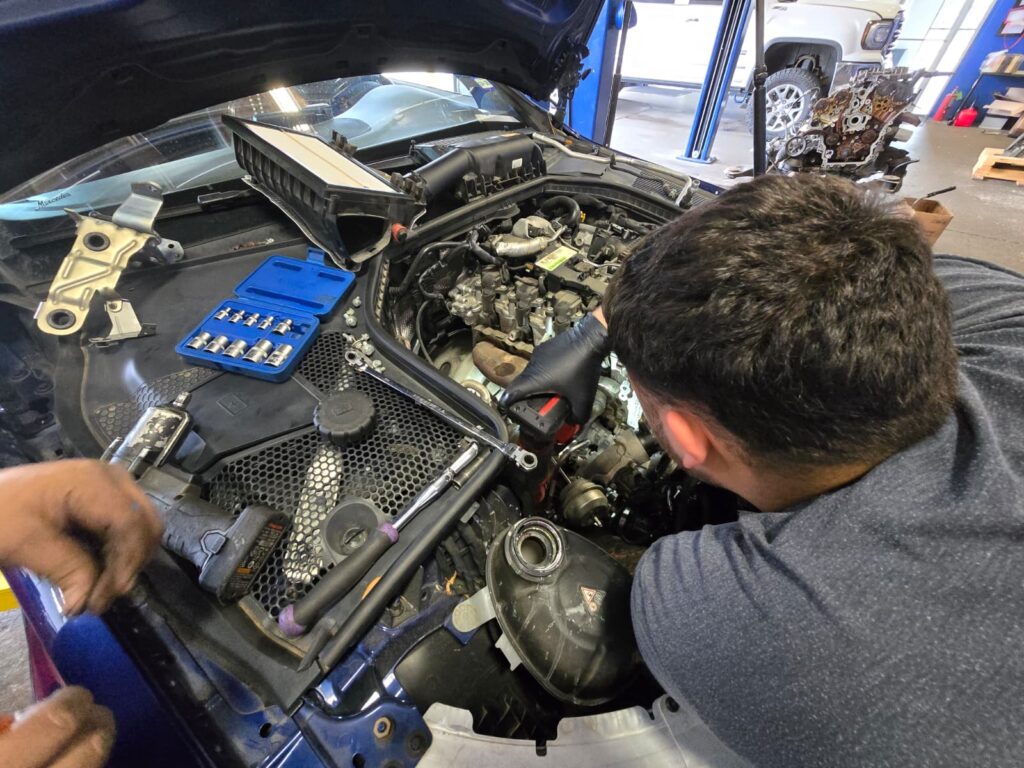
The technician started with an OBD-II scan, pulling the diagnostic trouble codes the car’s computer had already logged. In Jack’s case, the code pointed to cylinder 3. From there, the tech pulled the spark plug and coil pack from that cylinder to inspect them directly, rather than replacing parts on a guess.
That’s the difference between a shop that diagnoses and a shop that just swaps parts and hopes. Before any work started, the technician walked Jack through what the code meant, what they’d found on inspection, and what the repair would involve in plain language, not shop jargon.
Inside a Real Engine Maintenance Service Appointment
Jack’s visit turned into more than a single-part fix, because a misfire is often a sign it’s time for broader engine maintenance. A thorough visit typically covers:
- Spark plug and ignition inspection — checking wear, gap, and coil function across all cylinders, not just the one throwing a code
- Fuel system check — injector performance and fuel pressure, since a weak injector can mimic an ignition problem
- Compression test — only if the initial findings suggest a mechanical issue rather than an electrical one
- Fluid and belt inspection — oil condition, coolant levels, and belt wear, since these affect how hard the engine has to work
- Sensor and wiring check — ruling out a bad sensor before assuming the worst
In Jack’s case, it turned out to be a single worn spark plug and a coil pack starting to fail — not the fuel system, and not anything mechanical. That’s common. Most misfires trace back to ignition components, which is also the cheapest category of fix.
What It Cost Jack and What Affects Engine Repair Pricing in Webster, TX
Pricing for a misfire repair varies a lot depending on the cause, and any shop that quotes a number before diagnosing is guessing. Broadly:
- A diagnostic scan and inspection is usually a flat, modest fee
- Spark plug or coil replacement sits at the lower end of repair costs
- Fuel injector cleaning or replacement runs higher
- Compression-related repairs — like a head gasket — cost significantly more, because of the labor involved
Jack’s repair landed on the affordable end, because he brought the car in early. That’s the pattern worth noting: a misfire caught at the spark-plug stage is a routine fix. The same misfire ignored for months can quietly damage the catalytic converter, turning a small repair into an expensive one.
How Often You Actually Need Engine Maintenance
Most manufacturers recommend a full engine maintenance check every 30,000 miles, though spark plugs on some vehicles are rated for 60,000 to 100,000 miles depending on the type. Between scheduled visits, a few signs mean it’s worth coming in sooner:
- Rough idle or hesitation on acceleration
- Any check engine light, even if it seems minor
- A noticeable drop in fuel economy
- Unusual engine noise under load
Webster’s stop-and-go Houston-area traffic and long summer heat are both harder on ignition components and fuel systems than steady highway driving. Local driving conditions are a real reason to lean toward the shorter end of maintenance intervals rather than the longer one.
Question 1 : What does it mean when a car is misfiring?
Answer 1 : A misfire means one or more of your engine’s cylinders isn’t combusting fuel properly. It usually feels like a jerk, stumble, or rough idle, and often triggers the check engine light. Common causes include worn spark plugs, ignition coils, fuel delivery issues, or sensor faults.
Question 2 :Is it safe to drive with a misfiring engine?
Answer 2 :Short distances are usually fine, but driving on a misfire for an extended period can damage the catalytic converter and increase emissions system strain. If the check engine light is flashing rather than steady, get it looked at right away — that’s a more urgent warning.
Question 3 :How much does engine maintenance service cost in Webster, TX?
Answer 3 :Cost depends entirely on the cause. Spark plug or coil repairs are relatively affordable, while fuel system or compression-related issues cost more. A proper shop will diagnose first and quote based on actual findings, not a flat guess.
Question 4 : How often should I get engine maintenance?
Answer 4 :Most vehicles need a full maintenance check around every 30,000 miles, with some spark plug types lasting up to 100,000 miles. Houston-area heat and stop-and-go traffic can shorten that window, so watch for rough idling or power loss between visits.
Question 5: Can a bad spark plug really cause a misfire?
Answer 5 :Yes — worn spark plugs are one of the most common misfire causes. As plugs age, they lose the ability to create a strong, consistent spark, which can cause a cylinder to fire unevenly or not at all.
Get Expert Engine Maintenance & Misfire Diagnosis in Webster, Texas
If your car is misfiring, running rough, losing power, or the Check Engine Light is on, don’t ignore the warning signs. At Bay Area Auto, we provide professional Engine Maintenance Service in Webster, Texas, including engine diagnostics, misfire diagnosis and repair, spark plug and ignition coil replacement, fuel system inspections, oil and filter changes, fluid checks, and preventive maintenance. Our experienced technicians accurately identify the cause of engine misfires and perform the repairs needed to restore your car’s performance, reliability, and fuel efficiency.
📞 Call us: +1 346-447-7171
🌐 Visit: https://bayarea-auto.com/
📍 Address: 301 W Bay Area Blvd, Webster, TX 77598, United States
Our support team is available Monday through Saturday, 7:30 AM to 6:00 PM, to assist you quickly and efficiently.
Visit Bay Area Auto or WhatsApp us for a professional engine inspection and misfire diagnosis.