Emily Laughrun, an experienced interior designer known for her attention to detail, became concerned when her car’s oil pressure warning light briefly flashed during startup and disappeared moments later. Later that day, she also heard a faint ticking noise from the engine that faded as it warmed up. While these signs seemed minor, Emily knew that small warning signals often point to bigger problems, so she decided not to ignore them and looked into the issue before it could become a costly repair.
She searched that evening for the Best Auto Repair Shop Webster, Texas not because anything felt urgent, but because she wanted to understand what these two things meant before deciding whether they were worth worrying about.
Why Brief Warning Lights and Startup Noises Deserve Attention
Before calling, Emily looked up both symptoms separately.
A low oil pressure warning light that appears briefly at startup and then disappears is a pattern many drivers have experienced and many drivers ignore — because it does not stay on, and the car seems to run fine afterward. What this pattern often indicates is that oil pressure takes a moment longer than it should to build to normal levels when the engine first starts. In a healthy engine with full oil levels and a properly functioning oil pump, pressure builds almost instantly. A brief delay can indicate the oil level is lower than it should be, the oil has degraded and lost viscosity, or there is a developing issue with the oil pump or pressure sensor itself.
A ticking sound at startup that fades as the engine warms is frequently associated with valve train components specifically, lifters or the timing chain and its tensioner running with insufficient lubrication in the moments after startup, before oil has fully circulated and built pressure throughout the engine. As oil warms and circulates, the lubrication improves and the noise often fades, which is exactly why it seems to “go away.”
Individually, either symptom alone might be coincidental. Together — a brief low oil pressure indication and a startup ticking noise that both occur around the same time — they point toward the same underlying area: the engine may not be receiving adequate oil pressure quickly enough at startup, and something in that chain of cause and effect needs to be identified.
Emily called the next morning.
Eric answered and listened as Emily described both symptoms — the two-second oil pressure light the previous morning, and the startup ticking that evening, both gone within seconds and not recurring since.
Eric: You are describing two things that, on their own, a lot of people would not think twice about. Together, and around the same timeframe, they are worth looking into. Has anyone checked your oil level recently — do you know roughly where it sits right now?
Emily: I checked it myself this morning after the ticking noise. It looked low — below the minimum mark on the dipstick. My last oil change was about four months ago, and I usually get about six months out of an oil change without needing to top up in between.
Eric: That is useful information. An oil level that has dropped noticeably below normal between changes, combined with a brief startup pressure warning and a startup tick, suggests the engine may be losing oil somewhere — either through consumption (burning oil) or through an external leak. Both are worth identifying, because the consequence of running an engine low on oil for an extended period is accelerated wear on exactly the components that produced that ticking sound — and eventually, on the engine’s bearings, which is a much more serious and expensive failure.
Emily: Should I top off the oil before driving it in, or leave it as is?
Eric: If you have the correct oil type on hand, topping it off to a safe level for the drive in is reasonable — that protects the engine for the trip. But do not assume that solves anything. We need to find out why the level dropped in the first place. Bring it in and we will do a full inspection — oil level and condition, leak inspection, and a cold-start observation if needed to check for the ticking sound directly.
Emily topped off the oil with what she had at home and drove to the shop that morning.
Emily Arrives at the Best Auto Repair Shop Webster Texas
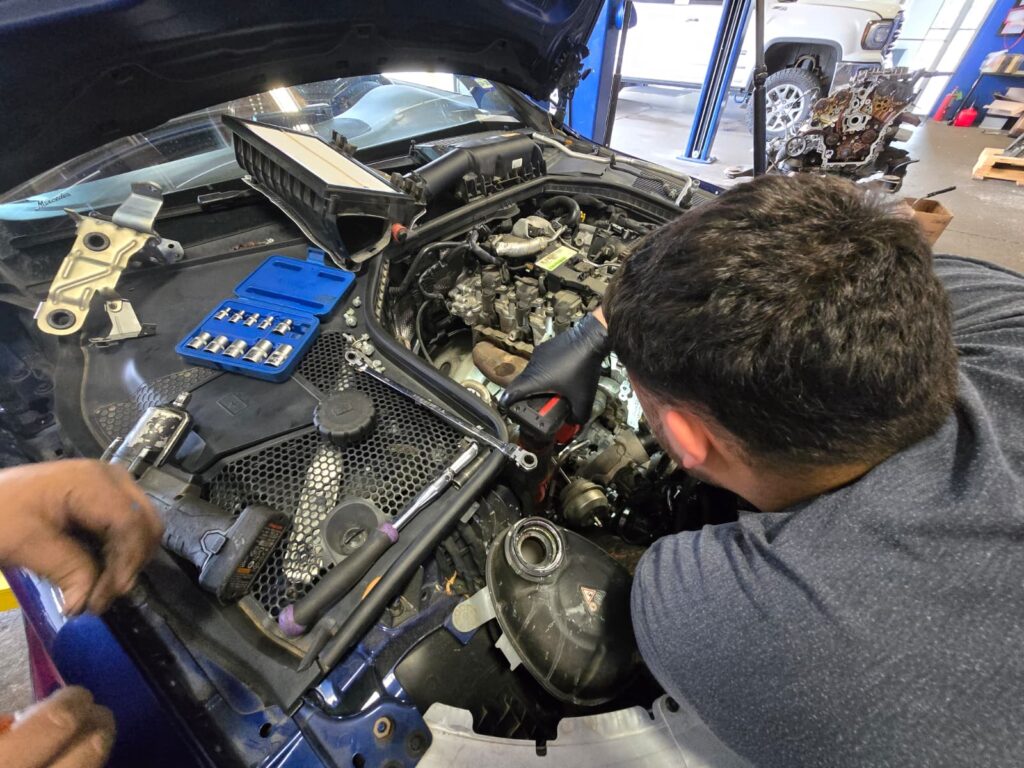
When Emily arrived, Eric began with a visual inspection of the engine bay and the underside of the vehicle before doing anything else.
He checked the oil level again, confirmed it was now at a safe level following Emily’s top-off, and then began looking for signs of an external leak — checking the oil filter housing, the valve cover gasket area, the oil pan, and the area around the front timing cover, all common locations for oil seepage in vehicles of this age and mileage.
Eric: I can see some oil residue around the valve cover gasket area, and there is a small amount of staining lower down near the oil pan as well. Before I conclude anything, I want to clean these areas, add a UV-reactive dye to the oil, and run the engine for a short period. The dye will glow under UV light wherever oil is actively escaping, which tells us definitively where the leak is rather than guessing based on where old residue has accumulated over time.
While the dye circulated, Eric also performed a cold-start test — letting the engine sit until it cooled to ambient temperature, then starting it while listening closely to the engine bay.
The ticking sound was present, exactly as Emily had described — faint, present for roughly the first ten seconds, then fading as the engine ran.
Eric: That confirms the symptom. The timing is consistent with oil pressure taking slightly longer than normal to reach the upper valve train components at startup. Combined with the oil level being low, this is very likely related to the same underlying cause — a leak that has been slowly reducing the oil level over the past months, reaching a point where startup lubrication is now measurably delayed.
What the UV Dye Test Found
After the engine ran for the specified period with the dye circulated, Eric used a UV light to inspect the underside of the engine and the surrounding components.
The result was clear: a steady, glowing trace of dye was visible at the valve cover gasket, specifically along the rear section where it is more difficult to see during a routine visual inspection. The staining lower near the oil pan turned out to be older residue from the same leak, dripping down and accumulating over time rather than indicating a separate leak at the pan itself.
Eric: This is the source. The valve cover gasket has degraded — likely hardened and shrunk slightly with age and heat cycling, which is normal for a gasket at this point in the vehicle’s life. It is no longer sealing completely, and oil has been seeping out gradually. Slowly enough that it would not show up as an obvious puddle under the car, but steadily enough to drop your oil level meaningfully between changes.
Emily: And that’s also connected to the ticking and the warning light?
Eric: Yes. As the oil level dropped, the oil pump had to work slightly harder and the system took marginally longer to build full pressure at startup — hence the brief warning light. And the valve train components at the top of the engine, which are the first to receive oil and the last to stay lubricated if the level drops, started showing that delay as a ticking sound until pressure normalized after a few seconds of running.
Emily: Is the engine damaged from this?
Eric: Based on what we are seeing — the timing of when you noticed the symptoms, the fact that the oil level was low but not critically low, and that the ticking faded completely after startup rather than persisting — I do not see evidence of significant wear yet. This is the kind of thing that, caught here, results in a gasket replacement. Left for several more months, continuing to lose oil at this rate, you would eventually run the engine critically low on oil — and that is when bearing damage and serious engine failure become real possibilities, not just theoretical ones.
The Repair
The valve cover gasket replacement was completed the same day.
The process included:
- Valve cover removal — Disconnecting related components (ignition coils, wiring harnesses, intake components as needed for access) and removing the valve cover
- Old gasket removal and surface cleaning — The mating surfaces on both the cylinder head and the valve cover were cleaned thoroughly to ensure the new gasket would seal properly
- New gasket installation — A new gasket, matched to the vehicle’s specifications, was installed and the valve cover torqued to the manufacturer’s specified sequence and value — over-tightening can distort the cover and cause new leaks, so correct torque matters
- Component reassembly — All disconnected components were reinstalled and reconnected
- Oil level correction — The oil was brought to the correct level and the oil condition was assessed; given the circumstances, an oil change was recommended and performed at the same time, since the oil had likely been running closer to its service interval limit while also being slightly low
- Post-repair leak check — The engine was run, and the previously identified leak area was rechecked under UV light to confirm no further leakage
- Cold-start verification — On a subsequent cold start, the ticking sound that had been present before was absent
Why "It Went Away" Is Not the Same as "It's Fine"
Many of the warning signs that precede serious engine problems share a common trait: they are intermittent, brief, and often disappear before the driver has time to fully register them. This makes them easy to dismiss — and that ease of dismissal is exactly what allows underlying problems to progress from minor to severe.
Signs worth taking seriously even when they are brief or intermittent include:
- Any warning light, even one that appears briefly and turns off — Warning lights are triggered by sensor thresholds. A brief trigger means the threshold was reached, even momentarily
- New sounds that appear only under specific conditions — Startup, cold weather, acceleration, or turning — and then seem to resolve
- Oil level changes between scheduled oil changes — Oil should not need topping off in normal operation between intervals. If it does, something is consuming or losing oil
- Any change in how the engine sounds, feels, or responds — Even subtle ones, especially if you are someone who drives the same car regularly and would notice a change
A Engine Repair Shop Webster Texas that takes these early, brief symptoms seriously rather than waiting for them to become persistent or severe is the difference between a gasket replacement and an engine rebuild.
Question: What does a brief low oil pressure warning light at startup mean?
Answer: A low oil pressure warning light that appears briefly at startup and then turns off typically indicates that oil pressure is taking slightly longer than normal to build to operating levels when the engine first starts. Common causes include a low oil level, degraded oil that has lost viscosity, or early wear in the oil pump. While the light turning off suggests pressure does eventually normalize, the delay itself indicates something has changed from normal operation and should be checked, particularly if it recurs or is accompanied by other symptoms like unusual sounds.
Question: Is a ticking noise from the engine at startup serious?
Answer: A ticking noise present only at cold startup and fading as the engine warms is often related to valve train components — lifters, the timing chain, or its tensioner — running with reduced lubrication in the moments before oil fully circulates. This can be a normal characteristic of some engines in small amounts, but a new ticking sound that did not exist before, especially combined with other symptoms like a low oil level or a brief warning light, indicates the lubrication system is not performing as it should and warrants inspection.
Question: What happens if an engine runs low on oil for an extended period?
Answer: Running an engine with insufficient oil causes increased friction and heat at every moving component the oil is meant to lubricate and cool. In the early stages, this accelerates wear on valve train components, which can produce ticking or tapping sounds. If the condition continues or worsens, it progresses to wear on the engine’s bearings — the components that support the crankshaft and connecting rods. Bearing damage from oil starvation is one of the most serious and expensive forms of engine failure, often requiring a full engine rebuild or replacement.
Question: How is an oil leak diagnosed and located accurately?
Answer: The most reliable method is a UV dye test, where a fluorescent dye is added to the engine oil and circulated by running the engine for a period of time. A UV light is then used to inspect the engine and surrounding components — any active leak point will show the dye glowing at the source. This method distinguishes between an active leak and old residue or staining from a previous, already-addressed issue, which a purely visual inspection often cannot do reliably.
Question: How often should I check my oil level between scheduled oil changes?
Answer: Checking the oil level once a month, or before any long drive, is a reasonable habit for most vehicles. In a vehicle with no leaks and normal oil consumption, the level should remain essentially unchanged between oil changes. If you find yourself needing to top off the oil between changes — even by a small amount — that is a sign worth investigating, since it indicates the engine is losing oil somewhere, whether through consumption or an external leak.
Contact Bay Area Auto Today
Don’t wait for a small warning sign to turn into a major repair bill. If your vehicle is showing unusual noises, dashboard warning lights, or performance issues, have it inspected by experienced technicians as soon as possible.
 Call us: +1 346-342-4417
 Visit: https://bayarea-auto.com/
Address: 301 W Bay Area Blvd, Webster, TX 77598, United States
Whether it’s a routine inspection or a complex engine repair, the team is ready to help you diagnose the problem and get you back on the road with confidence. Our support team is available to assist you quickly and efficiently.
Read Our Latest Blog Posts :-