Jean Lainez first noticed the sound on a Monday morning.
She was pulling out of her neighbourhood in Webster and merging onto the main road toward the Texas Medical Center, where she worked as an administrative coordinator. The commute was familiar — the same turns, the same stretch of highway, the same playlist on low in the background.
And then, somewhere between second and third gear, there was a noise.
It was faint. A low, soft whine that appeared when the transmission shifted upward and faded once the gear settled. She turned the music down slightly and listened. The noise appeared again on the next shift. Then the road opened up, the car moved into higher gears, and the sound stopped completely.
Jean turned the music back up.
She had a nine o’clock meeting. The noise was barely noticeable. It would probably go away on its own.
It did not go away.
Two Weeks of Hoping
Over the next two weeks, the noise changed in a way that Jean could not ignore.
It became slightly louder. It started appearing on downshifts as well — not just upshifts. Once, at a traffic light on Bay Area Boulevard, the car hesitated for a half-second before engaging when she pressed the accelerator. It was brief enough that she almost dismissed it. But she had never felt that hesitation before, and she felt it twice more in the days that followed.
Jean was not a mechanic. She did not know what a torque converter sounded like or what a solenoid did. What she knew was that her car was doing something it had not done before, that the something was gradually becoming more noticeable, and that every article she had read online in brief worried searches between meetings had said some version of the same thing:
Transmission problems do not heal on their own. They get worse.
On a Friday afternoon after work, she searched for the Best Auto Repair Shop Webster Texas not just for a transmission check, but for a place that could explain what they found in terms a non-mechanic could understand and follow.
She found a name with reviews that mentioned exactly those things: honest communication, explained repairs, and no surprises on the final bill.
She called before she left the parking garage.
Eric Picks Up the Phone
Eric answered on the second ring.
Jean described everything she had noticed — the whining noise during gear shifts, the sound that had started on upshifts and moved to downshifts, the brief hesitation at the light. She mentioned the two-week timeline and admitted she had been hoping it would resolve by itself.
Eric: You are not alone in that. Most people wait a few weeks before calling, hoping it is something minor. The challenge with transmission symptoms is that the things causing them tend to wear further the longer they run without being addressed.
Jean: Is this serious? When I searched online, it mentioned things like torque converters and solenoids, and the cost numbers I saw were fairly alarming.
Eric: I understand why that is concerning. But the right answer to how serious it is comes from an inspection, not from a search result. What you are describing — a progressive whining noise on shifting combined with a brief hesitation — could be a few different things. Some of them are straightforward. Some require more involved work. We need to look at it before I can tell you anything meaningful about cost.
Jean: Can I bring it in tomorrow morning?
Eric: Yes. Come in first thing and we will get the diagnostic started.
Jean locked her car and drove to the shop the next morning.
Jean Arrives at the Best Auto Repair Shop Webster Texas
When Jean arrived, Eric met her at the service entrance and asked her to describe the noise one more time — not because he had forgotten, but because he wanted to hear how she described it in person, which often added details that a phone call missed.
She described the shift pattern. She mentioned that the hesitation felt like the car was making a decision.
Eric nodded.
Eric: That hesitation you are describing is the transmission taking slightly longer than it should to engage after the shift signal. In an automatic transmission, that engagement is controlled in part by the solenoids small valves that regulate hydraulic fluid pressure to move the gears. When solenoid function degrades, you get delayed engagement. The whining sound often comes from the torque converter or from low fluid pressure causing internal components to work harder than they should.
Jean: So it could be the fluid?
Eric: It could be. Or it could be a solenoid, or both. The diagnostic will tell us. We will scan the transmission control module for error codes first, then do a fluid inspection — checking the level, the color, and whether there is any metallic debris in the fluid, which would indicate internal wear. Then we drive the vehicle under controlled conditions to confirm what we are hearing matches what the scan is showing.
He handed Jean a form confirming what the diagnostic would cover and the cost for the inspection itself, separate from any repair.
She signed it and went to the waiting area.
What the Inspection Found
An hour and fifteen minutes later, Eric came to the waiting area with the inspection report.
Jean sat forward.
Eric: The good news is that the internal components — the clutch packs, the band assemblies, the planetary gears — are not showing signs of significant wear. No metal debris in the fluid. No catastrophic damage codes.
Jean: That is a relief. What is causing the noise and the hesitation?
Eric: Two things. The transmission fluid is badly degraded. It has gone dark brown, which means it has oxidized and lost its lubricating and hydraulic properties. Dark fluid cannot maintain the pressure the solenoids need to operate cleanly, which explains the hesitation. The whining noise is coming from the torque converter — specifically the needle bearings inside, which are starting to show wear, likely accelerated by the degraded fluid running through the system.
Jean: Is the torque converter repairable?
Eric: In your case, based on what we are seeing, a full transmission fluid flush and filter replacement is the first step. That addresses the fluid quality and the solenoid performance immediately. For the torque converter, the bearing wear is early-stage — it has not progressed to the point where replacement is urgent, but it is something we should monitor at your next service interval. If the noise continues after the fluid service, we revisit the converter at that point.
He placed the written estimate on the table in front of her.
Jean read it carefully.
The fluid flush, new transmission filter, and a full fluid system inspection — itemized clearly, with labor and parts listed separately.
Jean: This is much less than I expected after reading about torque converters online.
Eric: Because the torque converter does not need replacing today. Recommending a repair before it is necessary does not help you — it only costs you money you did not need to spend.
Jean appreciated that more than she said.
The Repair Process What a Transmission Fluid Service Actually Involves
Most drivers hear “transmission flush” and picture a simple fluid top-up. A proper Transmission Repair Service Webster Texas is considerably more involved:
- Transmission control module scan — Reads stored and active fault codes to identify any electronic or solenoid-related issues before physical work begins
- Fluid condition inspection — Color, viscosity, and debris analysis to determine how far the fluid has degraded and whether internal wear is present
- Full fluid drain — Removes all existing fluid from the pan, not just a partial exchange, which is the only way to fully replace degraded fluid
- Filter replacement — The transmission filter catches particulate matter from normal wear. A clogged or saturated filter restricts fluid flow and compounds pressure issues
- Pan cleaning and gasket replacement — The transmission pan is cleaned of any sludge or deposits before being resealed with a fresh gasket
- Correct fluid specification — Not all transmission fluid is the same. The correct fluid type for the vehicle’s specific transmission model is critical — using the wrong specification can cause shifting issues or damage internal components
- Post-service road test — The vehicle is driven after the service to confirm shifting behavior has normalized and the symptoms have been resolved
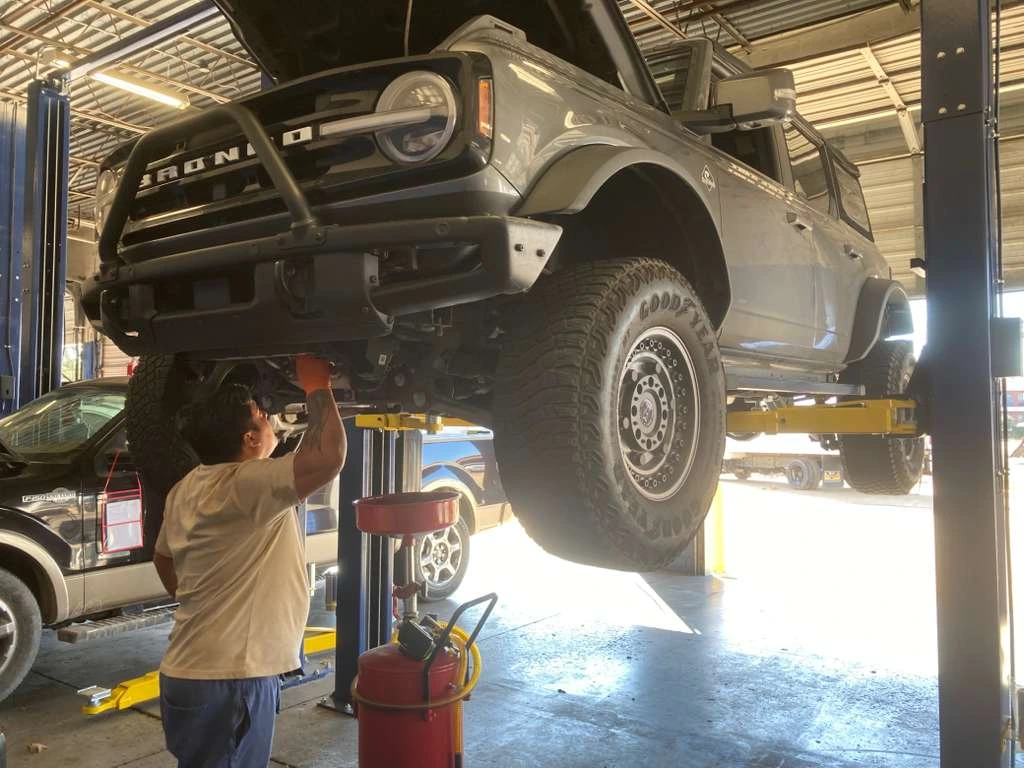
Jean watched part of this process from the doorway. Every step was visible, documented, and explained when she asked.
When the car was returned that afternoon, Jean drove out of the parking area and onto the road.
The difference was immediate.
The shifts were smooth — no hesitation, no whining. The car moved through the gears the way it had when she first bought it. The sound she had been monitoring for two weeks was simply gone.
She drove a familiar stretch of road and listened carefully.
Nothing but the road and the music.
That evening, Jean sent a message to her colleague Sandra, who had mentioned the previous week that her own car had been making an unusual sound when shifting from park into drive.
Jean kept the message simple: she sent the contact number, a single sentence about what the shop had found on her car, and one more sentence:
They explain everything and the bill matches what they tell you before they start.
Sandra called the following morning.
Why Transmission Symptoms Should Never Wait
Transmission problems share one characteristic that makes them different from many other mechanical issues: they are almost always progressive. What starts as a faint noise or a brief hesitation is the system communicating that something has begun to change. Addressed early, the repair is often straightforward and affordable. Ignored, the same problem compounds — degraded fluid accelerates wear on solenoids, worn solenoids strain the valve body, strained valve body components affect clutch engagement, and what began as a fluid service becomes a full transmission rebuild.
Jean’s two-week delay was long enough for the torque converter to begin showing early bearing wear that a timely fluid service might have prevented entirely.
The warning signs that deserve an immediate inspection include:
- Whining, humming, or buzzing during gear shifts — Often indicates fluid pressure issues or early torque converter wear
- Delayed engagement or hesitation — The transmission is taking longer than normal to respond to the gear signal
- Rough or jerky shifts — Inconsistent hydraulic pressure or solenoid performance
- Slipping between gears — The transmission briefly loses the current gear before re-engaging
- Burning smell — Severely degraded or overheated transmission fluid
- Check engine or transmission warning light — The control module has logged a fault that should be read and diagnosed immediately
Any one of these symptoms is a reason to visit the Best Auto Repair Shop Webster Texas before the situation moves from manageable to serious.
Question: What does a whining noise from a transmission usually mean?
Answer: A whining or humming sound during gear shifts most commonly indicates degraded transmission fluid that has lost its hydraulic properties, early wear in the torque converter’s internal bearings, or a failing transmission pump. In many cases, the noise is the first sign that fluid quality has deteriorated to the point where internal components are working harder than they should. Early diagnosis almost always results in a simpler, less expensive repair.
Question: Is it safe to keep driving with a transmission noise?
Answer: It depends on the nature of the noise and how long it has been present. A faint intermittent whine on shifting may indicate early-stage fluid degradation that can be addressed with a service. Grinding, harsh clunking, or a noise accompanied by hesitation or slipping gears is a stronger signal to stop driving and have the vehicle inspected immediately. Continuing to drive with moderate to severe transmission symptoms accelerates internal wear significantly.
Question: How much does a transmission inspection and fluid service cost in Webster, TX?
Answer: A diagnostic scan and fluid inspection typically costs between $80 and $150 depending on the shop. A full transmission fluid flush with filter replacement ranges from $150 to $300 for most vehicles. These figures vary based on the vehicle’s transmission type and fluid specification. Any shop that provides a cost estimate for transmission work without first completing a diagnostic inspection is guessing — and guessing in the wrong direction is expensive.
Question: How long does a transmission diagnostic and fluid service take?
Answer: A full diagnostic scan including a road test typically takes 60 to 90 minutes. A transmission fluid flush and filter replacement adds another 90 minutes to two hours depending on the vehicle. A reputable shop will provide a clear timeline before beginning and contact you if anything discovered during the service changes the scope of the work.
Question: What causes delayed or rough shifting in an automatic transmission?
Answer: The most common causes are degraded transmission fluid that cannot maintain consistent hydraulic pressure, a faulty or failing shift solenoid that controls fluid flow to the gear actuators, a clogged transmission filter restricting fluid circulation, or wear in the valve body that regulates hydraulic pressure distribution. Electronic faults in the transmission control module can also cause shift timing issues. A diagnostic scan identifies which of these is responsible before any physical repair begins.
Conclusion
Jean Lainez spent two weeks hoping a problem would disappear.
It did not — but because she acted before the early-stage wear became structural damage, what could have been a significant transmission repair was resolved with a fluid service and a written note to monitor the torque converter at the next interval.
That outcome did not happen by luck. It happened because she found the Best Auto Repair Shop Webster Texas — one that diagnosed honestly, explained clearly, repaired only what was necessary, and handed her a final bill that matched the estimate she approved before anyone picked up a wrench.
Transmission noises do not get quieter on their own. If something has changed in the way your vehicle shifts or sounds, a Transmission Repair Service Webster Texas inspection is the only way to know whether it is a simple service or something that needs immediate attention.
Contact Us
The right service starts with the right conversation.
Call us, tell us what is happening, and we will take it from there.
 Call us: +1 346-342-4417
 Visit: www.bayarea auto.com
You can also WhatsApp us or visit us at 301 W Bay Area Blvd, Webster, Texas.
Our support team is available Monday through Saturday, 7:30 AM to 6:00 PM, to assist you quickly and efficiently.
Schedule your inspection today and drive with confidence.