
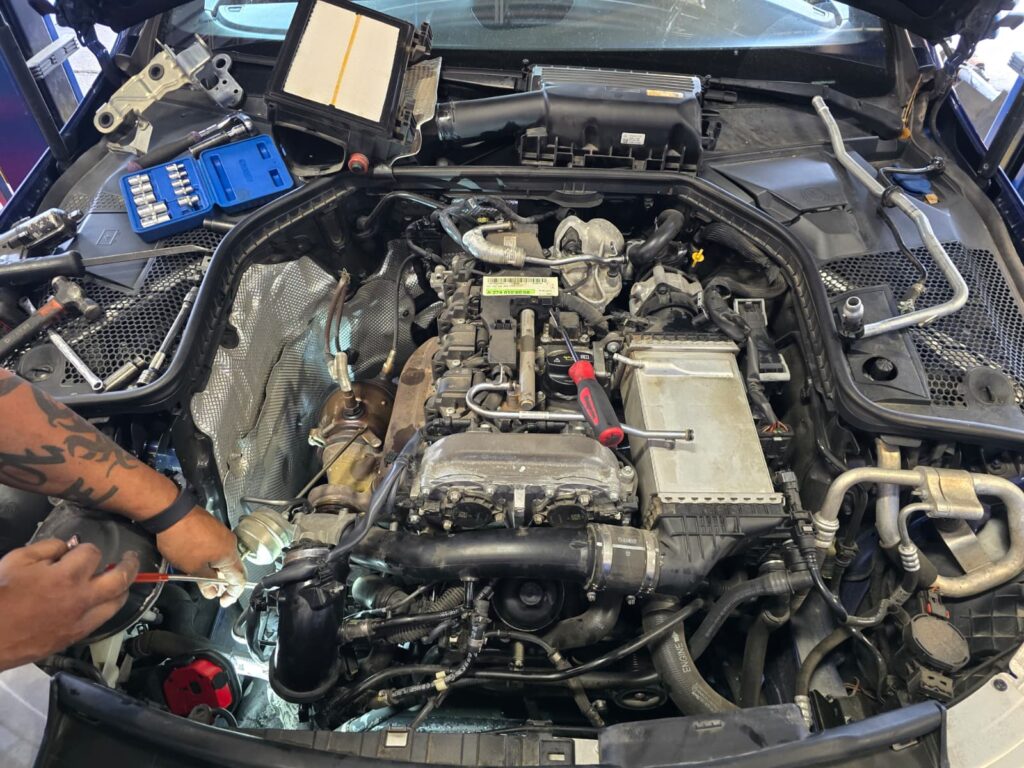
When Felicia Saw the Temperature Gauge Climb
Felicia manages a physical therapy clinic in Webster, and her commute is the same twenty-minute drive most weekday mornings. She knows that drive well enough to notice small things a new sound, a different feel in the steering, a gauge sitting somewhere it usually doesn’t.
About ten minutes into her drive, she glanced down and noticed the temperature gauge sitting higher than normal. Not at the top, just noticeably above where it usually settled once the engine warmed up. She watched it for another minute or two, half expecting it to level off the way it always had before.
Instead, it kept climbing, steadily, toward the red section of the gauge. There was no dramatic moment, no smoke pouring from under the hood, no burning smell. Just a needle moving in a direction she didn’t like.
She made the decision most drivers hesitate over: she pulled into the nearest parking lot, put the car in park, and shut the engine off before it reached the top of the gauge. No smoke, no unusual smell, no puddle forming underneath that she could see. Just an engine that had clearly been running hotter than it should.
An overheating engine sits in an unusual category of car trouble. It can mean something as simple as a low coolant level, or as serious as a cracked head gasket, and from the driver’s seat, those two situations can look almost identical in the first few minutes. Felicia didn’t want to guess which one she was dealing with, and she didn’t want to find out the hard way by continuing to drive.
A Call That Started With Safety, Not a Quote
Felicia called and spoke with Eric on the customer care line.
Eric’s first questions weren’t about scheduling or pricing. They were about her safety and the immediate condition of the car: Was she somewhere safe to wait? Had she kept driving after the gauge started climbing, or pulled over as soon as she noticed? Was there any smoke, steam, or unusual smell? Any fluid visible underneath the vehicle?
Felicia confirmed she’d pulled over quickly, before the gauge reached the top, and hadn’t pushed the car any further once she noticed the problem. There was no visible smoke, no smell of burning coolant, and she hadn’t looked underneath the car herself.
Eric told her that pulling over quickly was exactly the right call. Continuing to drive on a climbing temperature gauge, even for just another mile or two to reach a destination, is one of the most common ways a manageable cooling system issue turns into serious, expensive engine damage. He arranged to have her car brought in and looked at the same day, and talked her through what a safe wait would look like until it could be picked up.
Understanding How Your Cooling System Actually Works
Before getting into the inspection, Adam gave Felicia a quick, plain-language explanation of why a rising gauge happens at all, tying it directly to what she’d described.
Coolant absorbs heat from the engine and carries it to the radiator, where outside air and a fan pull that heat back out. A thermostat controls when coolant flows to the radiator, opening only once the engine reaches operating temperature. If a hose leaks, the thermostat sticks, or the fan doesn’t spin, that cycle breaks down and heat builds up faster than it can escape which is exactly the climb Felicia had watched on her gauge.
That’s why Adam wasn’t just checking one part. A gauge that climbs the way Felicia described could point to any piece of that cycle failing, so the inspection needed to check the system as a whole rather than guess at a single cause.
Diagnosing Before Assuming the Worst
When Felicia’s car came in, technician Adam started with the basics before assuming anything serious. Overheating can come from several sources, so he checked:
- Coolant level and condition in the reservoir and radiator
- Visible leaks at hoses, connections, and the water pump
- A cooling system pressure test to find leaks not visible at rest
- Thermostat function, since a stuck thermostat can cause rapid overheating
- Cooling fan operation, exhaust color, and oil condition as indicators of deeper issues
He also asked Felicia exactly how quickly the gauge climbed and whether it happened gradually over the drive or suddenly within a minute or two, since that timeline helps narrow down whether the cause is a slow leak that’s built up over weeks, or a component that failed outright that morning.
Quick Answer
An engine that overheats during normal driving is most often caused by a coolant leak, a failing thermostat, or a bad cooling fan not necessarily a head gasket problem. In Webster, Texas, Felicia’s temperature gauge climbed sharply during her commute, and a proper inspection found a small coolant leak at a hose connection along with a thermostat that wasn’t opening correctly, with no sign of head gasket damage. Diagnosing the actual cause before assuming the worst is exactly what a real Best Auto Repair Shop Webster, Texas drivers count on does with an overheating engine.
What the Inspection Found
The pressure test found a small coolant leak at a hose connection near the radiator. It wasn’t the kind of leak that would leave an obvious puddle overnight, but it was enough to gradually lower coolant levels over time, reducing the system’s ability to manage heat during a longer drive.
On top of that, thermostat testing showed it wasn’t opening at the correct temperature. Even with fluid in the system, coolant wasn’t circulating to the radiator the way it should have been, which meant heat was building up faster than it could be pulled back out.
Exhaust color was normal, with no white smoke, and the oil showed no signs of coolant contamination, both of which are strong indicators against head gasket damage. That combination — a leak plus a failing thermostat — was enough on its own to explain the rapid climb Felicia saw, without pointing to anything happening deeper inside the engine.
Ensuring the Engine Repair Was Fully Resolved
Adam repaired the leaking hose connection and refilled the cooling system with fresh coolant, then replaced the failing thermostat so the system could regulate temperature correctly again. The Engine Repair Service in Webster, Texas included a second pressure test after the repair to confirm the leak was fully resolved and wasn’t going to reappear after a few days of driving.
Adam then ran the engine through a full warm-up cycle on the lift, monitoring the temperature gauge directly and confirming the thermostat opened at the correct point, before taking the car on a road test that mirrored Felicia’s actual commute. The gauge held steady in the normal range the entire time.
What To Do If Your Car Starts Overheating
If your temperature gauge climbs or a warning light appears while driving, a few immediate steps matter more than diagnosing the cause yourself:
- Pull over safely as soon as you can, rather than continuing to your destination
- Turn off the engine and let it cool for at least 15–20 minutes before opening the hood
- Watch for smoke, a sweet smell, or fluid underneath the car
- Avoid opening the radiator cap or adding coolant while the engine is hot
- Have the car towed or brought in rather than continuing to drive on it, even for a short distance
Continuing to drive on an overheating engine is what most often turns a simple leak or thermostat issue into serious, expensive damage.
Preventing Overheating Before It Starts
Most overheating cases build up gradually rather than happening out of nowhere, which means most of them are preventable with basic attention. Coolant should be checked periodically and serviced according to the manufacturer’s recommended interval, since coolant does break down and lose effectiveness over years of use, even in a sealed system. Hoses and connections are worth a visual check during routine oil changes, since a small leak is much easier to catch and repair before it grows.
Paying attention to the temperature gauge on a normal, uneventful drive is one of the simplest habits a driver can build. Knowing where the needle usually sits makes it much easier to notice the moment something changes, the way Felicia did on a commute she’d driven a hundred times before.
Frequently Asked Questions
Question : 1 Why is my car overheating?
Answer : 1 The most common causes are a coolant leak, a failing thermostat, or a bad cooling fan. Head gasket damage is possible but less common, and a proper inspection is the only way to confirm which one is actually happening.
Question : 2 Is it safe to keep driving if the temperature gauge is rising?
Answer : 2 No. Continuing to drive on a rising temperature gauge is what typically turns a minor issue into serious engine damage. Pull over safely, let the engine cool, and have it inspected before driving further.
Question : 3 Does overheating always mean head gasket damage?
Answer : 3 No. Many overheating cases come from a coolant leak or a failing thermostat, both far less involved than head gasket repair. Signs like white exhaust smoke or milky oil point toward the head gasket specifically; a rising gauge alone does not.
Question : 4 How much does it cost to fix an overheating car?
Answer : 4 It depends on the cause. A coolant leak or thermostat replacement is one of the more affordable engine-related repairs, while head gasket repair costs significantly more due to the labor involved. A written estimate after inspection gives the most accurate number.
Question : 5 How often should my coolant be serviced to avoid overheating?
Answer : 5 This varies by vehicle, but most manufacturers recommend a coolant check or service at set mileage or age intervals, since coolant loses effectiveness over time even without a leak. Checking your owner’s manual or asking during a routine service visit is the simplest way to stay ahead of it.
Final Thoughts
Felicia’s overheating started with a gauge that climbed faster than she expected, on a drive she’d made a hundred times before. Pulling over right away, instead of pushing on to her destination, kept a fixable problem fixable.
Getting it diagnosed properly, rather than assuming the worst, showed the cause was a leak and a thermostat, not the more serious damage an overheating engine can sometimes mean, and kept the repair cost and time reasonable in the process.
For drivers in Webster whose car starts overheating, Bay Area Auto takes that same check-before-you-assume approach that got Felicia’s engine running at a normal temperature again.
 Call us: +1 346-447-7171
 Visit Our Website : https://bayarea-auto.com/
 Address: 301 W Bay Area Blvd, Webster, TX 77598, United States
Our support team is available Monday through Saturday, 7:30 AM to 6:00 PM, to assist you quickly and efficiently.
Visit Bay Area Auto or call ahead for a professional engine inspection.